
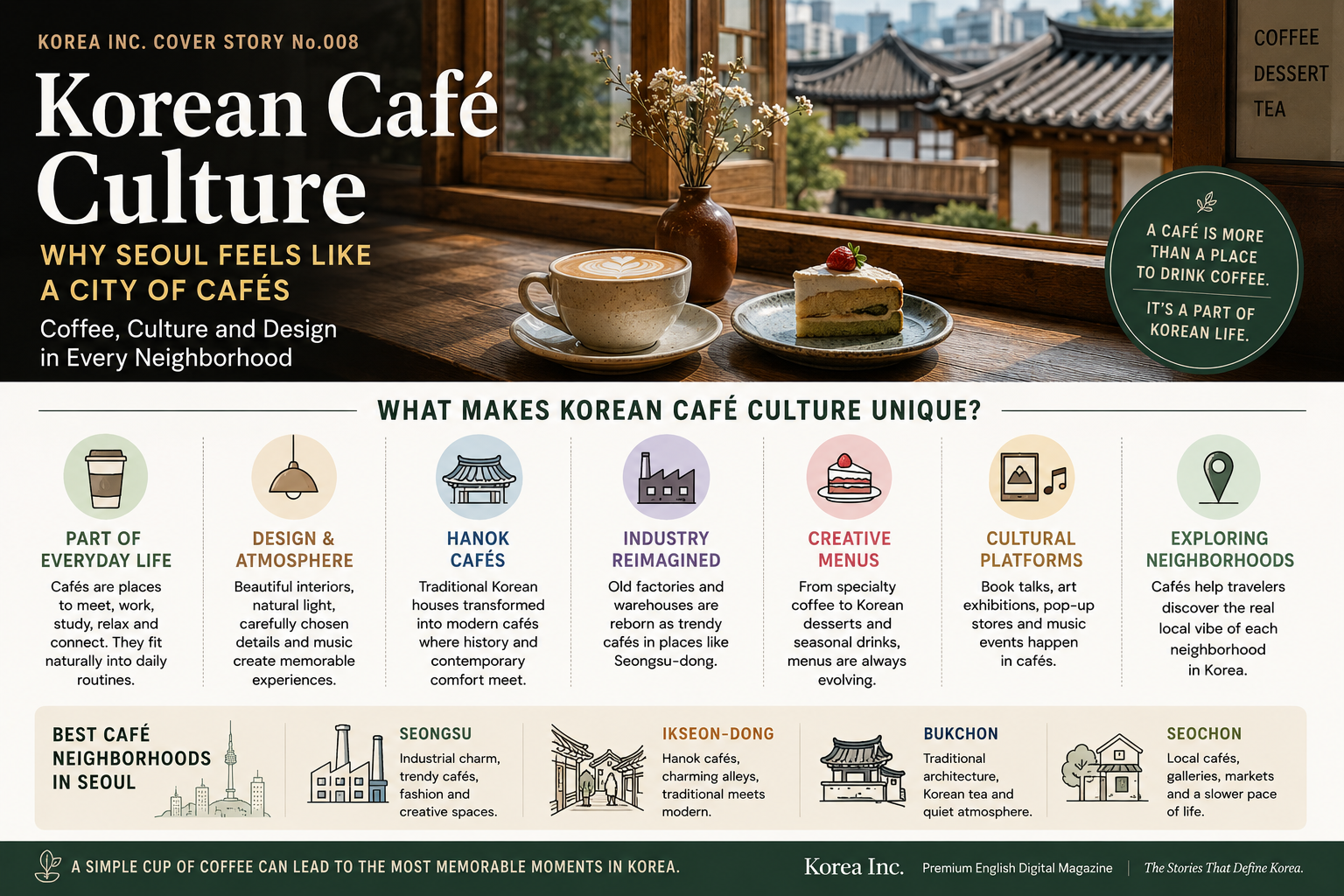
Korea Inc. Cover Story No.008
Korean Café Culture_Why Seoul Feels Like a City of Cafés
Hero Summary
In Seoul, a café is rarely just a place to drink coffee.
It can be a quiet workspace, a meeting point, a design destination, a dessert laboratory, a cultural venue, or simply a place to slow down for an hour.
That is what makes Korean Café Culture so distinctive.
From traditional hanok houses transformed into elegant cafés to old factories reborn as creative spaces, Korea has developed a café scene where coffee, architecture, lifestyle and culture meet.
Quick Facts
- Category: Trends
- Reading Time: 7–8 minutes
- Focus Keyword: Korean Café Culture
- Best For: First-time visitors, coffee lovers, culture travelers
- Best Cities: Seoul, Busan, Jeonju, Gyeongju
Article Highlights
- Why cafés became such an important part of Korean daily life
- How Korean cafés combine coffee, design and culture
- The appeal of hanok cafés
- Why old industrial spaces became trendy café destinations
- How cafés are becoming cultural platforms
- What travelers should look for beyond the coffee
More Than a Cup of Coffee
Walk through almost any busy neighborhood in Seoul and you will quickly notice something.
There are cafés everywhere.
But the interesting part is not simply the number of cafés. It is how differently they are designed and how many different purposes they serve.
A café might be a place to meet friends in the morning, work on a laptop in the afternoon, enjoy dessert in the evening, or discover a new neighborhood while traveling.
Korean cafés have gradually become part of the rhythm of everyday life.
And for international visitors, they offer something particularly valuable: a window into how modern Koreans live.
Why Cafés Became Part of Everyday Korean Life
Korea’s café culture developed alongside a fast-changing urban lifestyle.
As cities became increasingly dense and work and social schedules became more demanding, cafés provided flexible spaces between home, work and public life.
Today, a café can serve many roles at once.
It can be:
- A place for conversation
- A workspace
- A study room
- A date destination
- A meeting point
- A photography spot
- A place to experience new food and drinks
This versatility is one reason cafés have become so deeply integrated into Korean urban life.
The Café as a Design Experience
One of the first things international visitors notice is the importance of interior design.
Korean cafés often pay extraordinary attention to atmosphere.
Natural light, exposed brick, wooden furniture, concrete walls, carefully selected music and distinctive tableware can all become part of the experience.
The coffee itself is only one element.
The space around it matters just as much.
This is particularly visible in neighborhoods such as Seongsu, where old factories and industrial buildings have been transformed into cafés, restaurants, shops and cultural spaces.
VisitKorea describes Seongsu’s café district as an area where its industrial past continues to exist alongside trendy cafés and cultural spaces.
The result is something uniquely Seoul:
old architecture with a completely new purpose.
From Factories to Cafés: The New Seoul
Seongsu is perhaps one of the clearest examples.
The neighborhood was historically associated with factories, workshops and industrial businesses.
Today, visitors can walk among old brick buildings while discovering cafés, bakeries, fashion stores, exhibitions and creative spaces.
Some former industrial buildings have retained their original structures rather than being completely rebuilt.
That contrast has become part of their appeal.
The rough texture of an old warehouse can actually make a modern café feel more distinctive.
It is a perfect example of how Seoul repeatedly turns its past into something contemporary.
Hanok Cafés: Where Tradition Meets Modern Taste
At the opposite end of the design spectrum are Korea’s hanok cafés.
Traditional Korean houses, with their wooden structures, tiled roofs and courtyards, have been adapted into modern cafés and tea houses.
The experience is very different from sitting inside a contemporary concrete café.
Instead of urban minimalism, visitors encounter traditional architecture, warm wood, quiet courtyards and Korean tea or desserts.
Bukchon is one of the best-known areas for experiencing this combination.
VisitKorea’s current Bukchon guide specifically highlights cafés featuring Korean tea culture alongside the area’s traditional hanok architecture.
This combination of old and new is one of the most recognizable characteristics of modern Korean culture.
Coffee Is Only the Beginning
Korean cafés are also known for constantly experimenting with drinks and desserts.
A menu might include:
- Specialty coffee
- Matcha drinks
- Mugwort lattes
- Traditional teas
- Korean-inspired desserts
- Seasonal beverages
- Creative cakes and pastries
- Modern interpretations of traditional sweets
Some cafés reinterpret familiar Korean ingredients for contemporary tastes.
Mugwort, red bean, chestnut, sesame and persimmon can appear alongside espresso, milk, cream and modern pastry techniques.
VisitKorea, for example, features cafés combining traditional Korean desserts with contemporary presentation and flavors.
The result is not simply traditional food.
It is Korean tradition redesigned for modern life.
Cafés Are Becoming Cultural Platforms
Perhaps the most interesting development is that cafés are no longer limited to serving food and drinks.
According to Korea’s Ministry of Culture, Sports and Tourism, cafés are increasingly becoming platforms for cultural activities, including book readings, music events, fashion promotions and other experiences.
This explains why some Korean cafés feel more like small cultural spaces than conventional coffee shops.
A visitor might arrive for a coffee and discover:
- An art exhibition
- A book launch
- A pop-up store
- A listening session
- A fashion collaboration
- A design installation
The café becomes part of the experience rather than simply the background.
The Rise of the K-Café Experience
Korean café culture has also become increasingly interesting to international visitors.
The Korea Tourism Organization has actively highlighted Seoul’s café culture for foreign travelers, including dedicated K-café culture tours connected to international coffee events.
That is an important shift.
Visitors are no longer simply looking for famous tourist attractions.
They increasingly want to experience ordinary Korean life.
And cafés provide an easy entry point.
You can walk into a neighborhood café, order a drink, sit by the window and experience the city without following a traditional sightseeing itinerary.
Where to Experience Korean Café Culture
Seoul
Seoul offers the widest range of café experiences.
Seongsu
Best for:
- Industrial-style cafés
- Contemporary design
- Bakeries
- Fashion and lifestyle spaces
Ikseon-dong
Best for:
- Hanok cafés
- Traditional architecture
- Small alleys
- Modern Korean atmosphere
Traditional buildings in Ikseon-dong have been transformed into cafés, restaurants and other trendy destinations, creating a striking mixture of historic architecture and contemporary culture.
Bukchon
Best for:
- Hanok architecture
- Korean tea
- Quiet cafés
- Traditional atmosphere
Seochon
Best for:
- Neighborhood cafés
- Local food
- Galleries
- A slower, more residential atmosphere
VisitKorea describes Seochon as a place where cafés naturally coexist with local restaurants, markets and cultural spaces.
Beyond Seoul
The café experience does not end in the capital.
Cities such as Busan, Jeonju and Gyeongju offer their own interpretations of Korean café culture.
In Gyeongju, for example, cafés and restaurants have become part of the attraction around Hwangnidan-gil, where traditional buildings and contemporary businesses exist side by side.
This is one of the reasons café culture works so well for travelers.
The experience changes depending on the city and neighborhood.
How to Enjoy a Korean Café Like a Local
You do not need an elaborate itinerary.
Choose a neighborhood rather than a single café.
Walk around.
Look for a space that catches your attention.
Try a signature drink or dessert.
Then simply stay for a while.
The best part of Korean café culture is often not the destination itself.
It is the atmosphere between destinations.
A quiet afternoon in a small neighborhood café can sometimes tell you more about modern Seoul than another crowded tourist attraction.
Traveler’s Tips
- Explore neighborhoods rather than chasing only famous cafés.
- Try a signature menu item instead of ordering the same coffee everywhere.
- Visit hanok cafés to experience traditional architecture alongside modern café culture.
- Look for cafés inside converted industrial or residential buildings.
- Check opening hours before visiting, especially for small independent cafés.
- Expect queues at popular cafés, particularly on weekends.
- Use cafés as part of your neighborhood exploration, rather than treating them only as food stops.
Did You Know?
Korean café culture has roots that go beyond today’s specialty coffee scene.
Traditional dabang tea rooms played an important social role in Korea for decades, serving as places where people met, talked and listened to music.
VisitKorea notes that historic cafés such as Hakrim, which opened in 1956, have preserved this connection between cafés, artists, intellectuals and Seoul’s cultural history.
Today’s cafés may look completely different, but the underlying idea remains familiar:
a café is a place where people spend time together.
FAQ
What makes Korean Café Culture different?
Korean cafés often combine coffee with architecture, interior design, desserts, lifestyle and cultural experiences. The café itself can become part of the destination.
Are Korean cafés expensive?
Prices vary considerably. Independent specialty cafés and famous dessert cafés can be more expensive, while neighborhood cafés often offer more accessible options.
Are Korean cafés good for tourists?
Absolutely. They are one of the easiest ways to experience everyday Korean lifestyle without needing specialized cultural knowledge.
What is a hanok café?
A hanok café is a modern café located in or inspired by traditional Korean architecture. Many combine traditional spaces with contemporary coffee and dessert menus.
Which Seoul neighborhoods are famous for cafés?
Seongsu, Ikseon-dong, Bukchon and Seochon are among the most interesting areas for experiencing different sides of Seoul’s café culture.
Related Articles
Continue exploring Korea through these featured stories from Korea Inc.
- Why Korea Is Becoming One of the World’s Top Travel Destinations
- Korean Beauty | Why K-Beauty Continues to Influence the World
- Korean Food Guide | Must-Try Traditional Dishes and Local Favorites
- Seoul Travel Guide | Historic Palaces, Hidden Alleys and Modern Attractions
- Why Korean Cafés Are Unlike Anywhere Else in the World (Coming Soon)
Official Resources
Korea Tourism Organization’s official travel information and destination guides.
Official information about Seoul’s neighborhoods, culture and tourism.
Korea Inc.
Premium English Digital Magazine
The Stories That Define Korea.